
I used to tell people, in a rather grandiose fashion, that I was ‘a natural polemic’, which was unfortunate as that isn’t exactly what polemic means. But it sounded cool, and I was young and a loud-mouthed, opinionated dickhead.
One thing was true, though. I had no idea why I was like this. For instance, I crave routine even though I hate it. I find it mostly boring and, sometimes, borderline distressing. And yet it’s oddly comforting.
What's it all about?
I can be extraordinarily disciplined, yet hopelessly disorganised. I have an exceptional attention to detail whilst also being impossibly sloppy.
In my personal life, I’m incredibly shy and overwhelmingly anxious about everything. And yet I’ve thrown myself, totally unfiltered, into life, conversations, and terrifying social and professional situations. I’ve even done stand-up!
When I’m writing, I can spend hours getting something absolutely right, only to then delete it all because I’ve suddenly decided it needs changing or removing. Mostly, I find this irrationally gleeful.
To sum it up: my entire brain thing is rather frustrating and very tiring.
None of it made much sense to me until this last year or two, when I stumbled upon AuDHD, which, rather interestingly, points to the reason I’ve become the sort of writer I am.
What the hell is AuDHD?
“AuDHD is the shorthand term for people who have both autism and Attention-Deficit Hyperactivity Disorder (ADHD).”
The fascinating part is that the two conditions can produce apparently contradictory characteristics. Yeah, my mind leapt at that.
“Autism is often associated with a need for structure, routine and predictability, while ADHD can involve impulsivity, distractibility and a craving for novelty.”
…So what happens when you have both?
Before I go any further, I have a confession.
Am I AuDHD?
Not officially. I was diagnosed with autism in my 50s, which devastated me. I’d suspected I might be autistic, but having it confirmed was quite another matter.

Neurodiversity Symbol
My friends didn’t see much difference in me. Perhaps they noticed the depression and occasional angry outbursts, but internally, everything had changed. I was suddenly reassessing a lifetime of behaviour, relationships and experiences through an entirely different lens, and it destroyed me. I was not the person I thought I was. Contextually, everything changed, like that dolly zoom effect in Jaws. Yeah, I was Police Chief Brody on Amity Beach and about to lose my shit.
I was embarrassed for myself and at myself. It somehow made all of my many cringeworthy moments even more cringeworthy. It made me want to hide from the world, from me, from my memories, from everything.
To paraphrase. It weren’t very good.
Like a lot of ‘autists’ (as I call myself – it makes me sound a bit like an explorer navigating the pathways of my fucked-up brain), I’ve learnt to manage and reduce many of the hard edges of my condition. I became intensely observant, particularly regarding people’s reactions, tone of voice and spotting other outsiders. I also learned to mask, mostly at work and, of course, the general ‘learning how to fit into an annoying and confusing world’ thing. But don’t worry, I still stumble around social situations like a drunk dickhead dinosaur. Yay.
My issue, however, was that autism didn’t explain everything. I felt a little like an imposter. There were aspects of my behaviour that seemed almost to contradict what I’d learnt about the condition. My appetite for change, my chaotic approach to certain things, my sudden and sometimes ridiculous enthusiasms.
So with some reluctance, I started looking into ADHD. And to be fully transparent, I haven’t had a formal diagnosis. This post is my masturbatory interpretation of my behaviour, rather than some definitive neurological explanation. So yeah, if you want to accuse me of jumping on the ADHD bandwagon, as some right-wing pricks like to do, go ahead, but the more I’ve investigated AuDHD, the more things have made sense.
Particularly my writing.
Planning a novel. And then ignoring the plan
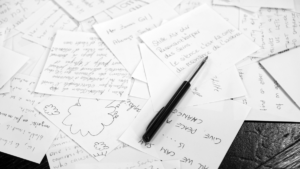
When I first started writing novels, I planned everything. Character sheets, plot outlines, backgrounds, timelines. And only then did I start the writing part of the author equation.
Of course… Nothing went to plan.
The characters did and said what they pleased, while the plot leapt screaming out of the window. All of it driving towards mysteries and things that needed to be solved. And the more I wrote, the more fun it became. Until… it wasn’t fun anymore.
I needed to carry out some pretty heavy and systematic rearrangement to resolve all the chaos. Meaning that the last third of writing a book became the most tedious and exhausting part of the whole thing. Sure, my problem-solving autistic side loved creating order, but the part of me craving novelty hated it. Which is why I kinda hate the entire process.
In the end, I gave up on the detailed planning altogether and became what writers call a ‘pantser’. Someone who writes by the seat of their pants, discovering the story as they go along, with some little bits of order inserted when my autie-mind can get a look in.

Despite this natural polemic (I know) the wonderful thing about pantser writing is that I genuinely don’t know what’s coming. The very act of writing generates ideas that would never have occurred to me while planning. It’s this constant discovery that keeps me interested. And that’s important because, as I’ve mentioned before, I actually find writing rather tedious.
Yes. I want to write books, but I don’t particularly enjoy the physical business of writing them.
Odd, isn’t it?
But this is where I think my autistic characteristics become useful. My persistence, attention to detail and need to see something through all help me finish projects even when my enthusiasm has largely buggered off somewhere else.
Or at least, that’s how I interpret it. And I’ve finished quite a few books this way. In fact… all of them.
I have no idea whether this is a typical AuDHD writing process. Probably not. But it seems to explain why I can be so undisciplined in how I write while remaining surprisingly disciplined about finishing what I’ve started.
The two characteristics aren’t necessarily fighting each other (although it feels like that). I think it’s that they’re just doing different jobs.
Which is just as well. Because I can also be astonishingly good at finding reasons not to write. Something that I share with most writers.
Hyperfocus… Or not?
Another interesting aspect of my perceived AuDHD condition is my ability to become completely absorbed in something.
When I’m going full-throttle on a project, I can work for hours, oblivious to almost everything else. Time becomes largely irrelevant. I forget to eat, drink, move.
And then from nowhere… I lose all interest and enthusiasm. It just goes away.
Hyperfocus occurs in both ADHD and autism, yet that sudden loss of interest seems more like ADHD to me.
The interesting thing is that I recognise it, meaning that even though I know what pleasure abandoning my writing day/s to a new obsession will bring, I can force myself to ignore it.
This is especially true when I’m editing a novel. I hate editing (apart from all the deleting, which I love, don’t ask me why), and distractions fly at me from every direction. It’s so utterly boring that only sheer bloody determination can get me through it. I have to get through it. But when I’m done?
Oh yeah, Baby!
That’s when I allow the distractions to rule. It’s like a reward.
Despite what I suspect are ADHD tendencies, I have learnt enough not to abandon everything. During one particularly intense distraction episode, I spent six months at the end of 2024 emulating a song from a band I was in from the 90s: Guilt Trip 5909.
I was obsessed with it, with getting it as close to perfect as possible. And to do that, I had to learn about VST synths, DAWs (digital audio workstations – in this case Ableton), singing, recording and then the totally mental process of mixing and mastering, which is a real art. Instead of getting overwhelmed and giving up, both sides of my brain worked together on this project. The problem-solving involved in listening to an electronically based song from 30 years ago and emulating it as closely as possible was wonderful.
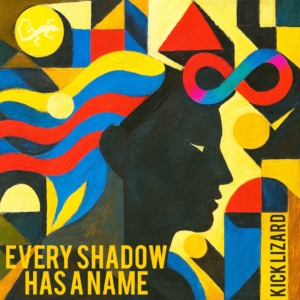
And when things became very difficult (as they always do, and I was losing my interest), I buckled down, finished it and went on to write a full album of electronic music: Every Shadow Has A Name as well as performing live gigs. Bloody Hell!
The productivity of not writing
My writing happens in bursts. Sometimes, I’m immensely productive, at other times, bugger all gets written, but that doesn’t mean I’m staring out of the window. Quite the opposite.
For me, the creative process is ongoing. Over a month, I will do a lot of things. For instance, over the last four weeks I’ve written one and a half screenplays, a brand new Scowl story (that I don’t like, but it’s finished) and remixed a song that was sent to me by LEKEMO one of my music buddies.
The month before that, I was obsessed with learning WordPress and created two brand new websites including this one!
This means that, despite my haphazard approach, I get an incredible amount of stuff done…
…Including writing.
Indeed, not writing is also part of the process of writing for me. I’m still being creative, just not necessarily writing books.
I don’t have to write a prescribed number of words per day. I just write when I feel like it. And edit when it needs to be done.
It never used to be this. I was a rather chaotic mess who was all over the place. But over time, I’ve wrested control away from that pleasure-seeking part of my mind (boo!) and have turned that chaos into an effective and productive cycle.
Now… What happens when my appetite for novelty gets the better of me? What happens when… I fuck up?
Changing things that didn’t need changing
Here’s a particularly stupid example:
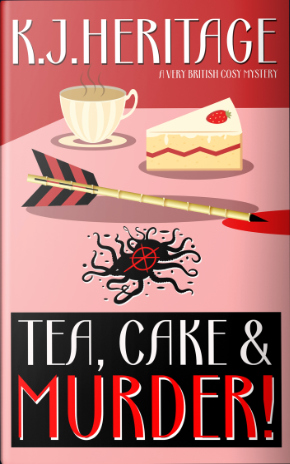
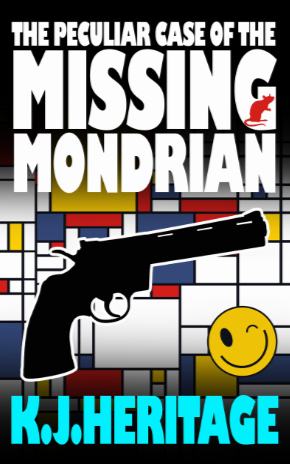
I originally published my books under the name: Kev Heritage. Me. A perfectly good name. Nothing wrong with it. Informal and impressive. A good name. I’d established myself as an author, had books published and was building something resembling a writing career.
But then, for reasons that I can no longer adequately explain, I decided to change my writing name to K.J. Heritage.
And my god, was I terribly excited about it? New name! New branding! New possibilities! A total re-organisation of all my then existing books, back matter, marketing, socials, etc. And a helluva lot of work.
It wasn’t as though I’d changed genre or wanted to separate two different kinds of writing. I simply decided that K.J. Heritage was a better idea. It wasn’t. It was incredibly stupid. One of the stupidest things I’ve ever done as an author.
I allowed my appetite for novelty to take control of a fun-filled, change-filled project that at the same time fed an autistic side that craved order.
The change had an entirely negative effect on my writing career. I’d spent time and effort establishing one name, only to start messing around with another, all for a couple of fucking initials. Yet I can still remember how exciting the idea seemed. I’ve had similar thoughts about changing it again. It’s ridiculous. But I’ve learned my lesson. Of course, I won’t change my name again.
Of course not.
But the worrying part of all of this is that I recently did exactly the same with my music. My band was originally called Trippt Lizard. Then I decided it should be Kick Lizard.
Why?
No particularly good reason apart from... see above.
Again, the whole business of changing the name, creating the new identity and rebuilding everything around it was enormously appealing. I loved all that.
And it doesn’t end there.
I’ve changed the titles and covers of books. Shattered Helix (free everywhere) was originally Vatic. Book two, Shattered Web was originally Ariadne. The Scowl was The Cowl. I’ve changed my website address, email address, my social media handles (anyone remember Mostly Writing?), and spent entirely too much time updating my back matter for every one of my books and their covers with every little fucking change. FFS!

The same fucking book!
What's in a screenplay?
I’ve also been adapting my novels into screenplays, including Dying Is Easy and Shattered Helix.
Now, I genuinely want to write for television, and adapting a novel into a screenplay is a legitimate creative exercise. It’s a very different discipline, requiring entirely different ways of approaching character, dialogue and structure. But there’s also something rather familiar about what I’m doing.
I’m taking something I’ve already created and rebuilding it.
Again.
And I have to wonder how much of the attraction comes from the creative challenge and how much comes from that familiar excitement of restructuring something that already exists. But while it’s not necessarily a bad thing—an adaptation can produce something entirely new and worthwhile—I have to be careful that I’m not just repeating the same old patterns.
So… Swings and Roundabouts.
Not quite playing the blame game
One thing I don’t want to do is start blaming every poor decision I’ve ever made on my ADHD side.
That would be ridiculous. People without ADHD also make impulsive decisions, become obsessed with projects, procrastinate and occasionally sabotage their own efforts.
And there’s no scientific evidence that changing your author name for no good reason is some defining AuDHD characteristic.
Sometimes a stupid decision is just a stupid fucking decision.
But when I look back over my writing career, I can see a recurring pattern. The problem comes when my appetite for novelty starts interfering with the things I’ve already achieved.
And the really annoying part?
I know that I’m doing it.
Conclusiony Bit
What I’ve found useful in exploring AuDHD isn’t that it’s provided a convenient excuse for all this behaviour. No. It’s that it’s given me another way of understanding the contradictions I’ve lived with for most of my life.
The science is still developing. There’s no single, established AuDHD personality, and my particular mixture of characteristics may be very different from someone else’s. For me, though, the possible connection between these seemingly opposing tendencies is fascinating.
It helps explain why I can embrace chaos while desperately wanting order. Why I can be utterly absorbed in something one day and completely indifferent the next. Why I can persevere through months of tedious work to finish a novel, then enthusiastically waste time changing something that was perfectly fine in the first place.
Like a twat.